Lannon Land Litigation Local Law, PLLCLannon Land Litigation Local Law, PLLC2026-10-09T09:53:10Zhttps://www.floridalocallaw.com/feed/atom/WordPress/wp-content/uploads/sites/1304544/2024/06/cropped-siteicon-32x32.jpgOn Behalf of Lannon Land Litigation Local Law, PLLC<![CDATA[Andrew Lannon Featured in The Florida Bar’s “The Capstone” Newsletter (Spring/Summer 2025)]]>https://www.floridalocallaw.com/?p=468172025-11-21T14:24:47Z2025-11-21T14:24:47ZThe Capstone is a resource dedicated to Florida’s Board Certified attorneys—the highest level of evaluation by The Florida Bar for competency and experience. Being highlighted in this publication is a testament to Mr. Lannon’s standing as a leader among the state's most qualified legal specialists.
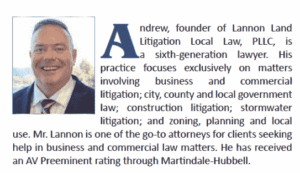
A Leader in Business & Local Government Law The feature profiles Andy’s unique qualifications as a sixth-generation lawyer and one of the few attorneys in Florida to hold double Board Certification. It specifically highlights his rare combination of expertise in Business Litigation and City, County, and Local Government Law—a distinction held by only two lawyers statewide.
The article also recognizes his consistent excellence and leadership in the legal community, noting that:
He is a member of Florida Trend’s Legal Elite Hall of Fame, having been selected for 10 consecutive years.
He has been selected to Florida Super Lawyers from 2021–2025.
He holds the prestigious AV Preeminent® rating from Martindale-Hubbell.
He has served in key leadership roles, including Vice-Chair of the Business Litigation Board of Certification Committee and Secretary of the City, County, and Local Government Law Section.
At Lannon Land Litigation Local Law, we strive to bring this same level of board-certified expertise to every case we handle, whether we are representing a business in a contract dispute or serving as a neutral arbitrator.
Read the Full Feature You can read the full profile and learn more about Florida Board Certification by downloading the newsletter below.
Download The Capstone (Spring/Summer 2025)]]>On Behalf of Lannon Land Litigation Local Law, PLLC<![CDATA[The hidden risks of verbal agreements in Florida business deals]]>https://www.floridalocallaw.com/?p=468002025-09-16T15:43:08Z2025-09-16T15:41:53ZWhy verbal agreements are risky
Trust is invaluable. But as much as it is a good thing to have in your business partner, it will not hold up in court like a proper contract will. The Statute of Frauds states that business agreements must be in writing for them to be enforceable. The hard truth is that it is just impossible to prove verbal promises however detailed they can get.
When you need to convince a judge about what the verbal agreement included, it is unlikely that they will believe it without documentation. Without the paper trail, everything comes down to credibility. If you are new to the industry, you might not have built enough to use in court.
Common disputes from handshake deals
When verbal agreements fail and two parties end up in a courtroom, their issues usually fall into a few familiar categories. These disputes normally include:
Payment disagreements
Partnership misunderstandings
Real estate or lease promises
Quality standards
Profit splitting
Imagine having to spend all that money on litigation that eats up time, money and energy when you should be focusing on your business instead. All that unnecessary stress when you could have just put everything in writing at the beginning.
How to protect your business
Thankfully, there are many ways for you to avoid these issues. For one, you can put everything in writing, even the simplest details. You also need to create a paper trail with texts or even emails. Use language or phrases like, “confirming that we are good to go as agreed” to establish that the conversation is not one-sided. If you are investing a huge amount of money, you can have professionals review the agreement to avoid loopholes or vague wording.
Put that promise on paper
Although handshake deals feel lighter and friendlier, they can easily turn into expensive courtroom nightmares. Prevent losses on both sides by taking the legal route and making sure you have all the necessary documentation. Follow proper procedure and save yourself the trouble of having to deal with a legal battle later.]]>On Behalf of Lannon Land Litigation Local Law, PLLC<![CDATA[What mistakes do business owners often make when facing a lawsuit?]]>https://www.floridalocallaw.com/?p=467932025-06-23T16:33:35Z2025-06-23T16:33:35ZMistake 1: Ignoring the problem
One of the biggest mistakes is ignoring the initial signs of a dispute. Hoping the issue will resolve itself can lead to more significant problems down the line. It is crucial to address conflicts early on and seek resolution before they escalate.
Mistake 2: Underestimating the importance of records
Documentation is key in any legal dispute. Business owners often make the mistake of assuming their word is enough. Collecting and presenting evidence, whether in the form of emails, contracts or witness testimonies, can strengthen your case significantly. You may also have the legal obligation to keep those records to preserve evidence.
Mistake 3: Waiting to seek legal advice
Many business owners delay consulting with a legal professional, often due to cost concerns. However, early legal advice can prevent further complications. An attorney with experience in business litigation can guide you through the process and advise on the best course of action.
Mistake 4: Overconfidence
Being overly confident can lead to a lack of preparation. Business owners sometimes assume they will win without understanding the complexities of the legal system. It is important to approach the situation with a realistic mindset and prepare thoroughly.
Mistake 5: Neglecting your business during the dispute
While dealing with a lawsuit, it is easy to become consumed by the legal process and neglect day-to-day business operations. It is crucial to maintain focus on running your business effectively to prevent additional issues.
Mistake 6: Not learning from the experience
Finally, failing to learn from the dispute is a missed opportunity for growth. Reflect on what led to the situation and implement measures to prevent similar issues in the future.
You can avoid mistakes and lay the groundwork for business litigation success
While lawsuits can be challenging, understanding these common mistakes can help business owners manage disputes more effectively. By staying informed and prepared, business owners can protect their interests and navigate the legal landscape with greater confidence.]]>On Behalf of Lannon Land Litigation Local Law, PLLC<![CDATA[What do small business owners need to know about breach of contract disputes?]]>https://www.floridalocallaw.com/?p=467622025-01-24T16:41:45Z2025-01-24T16:41:45Za competitive edge.
But what happens when something goes wrong? Business owners must often balance multiple contracts, and a breach can lead to significant disruptions and financial losses. A vendor may fail to deliver supplies by an agreed-upon date, or a client could refuse to pay for services rendered despite a signed contract. In these instances, business owners can take proactive steps to mitigate the negative impact of a breach.
Step #1: Review the contract
The language of the contract generally guides these disputes. This is why it is so important to review any proposed contract carefully. You can negotiate the terms and draft the contract to protect your interests.
When reviewing the document, review the contract for a provision the other party did not fulfill. Check the language used to see if the other party is in violation of the contract.
Step #2: Check for dispute resolution options
The contract itself may provide a method for resolving disputes. It may also be helpful to contact the other party. Many disputes can be resolved amicably through open dialogue.
If these steps fail to resolve the issue, consider the following legal remedies:
Mediation: A neutral third party can facilitate a resolution.
Arbitration: An arbitrator can render a binding decision to settle the dispute.
Litigation: There are instances when the other party will not cooperate. In these cases, it is best to take the matter to court to enforce the contract or seek damages.
Dealing with a breach of contract can be challenging, but understanding your legal options and obligations can help mitigate the impact on your business. By taking proactive steps towards resolution and compliance, you can safeguard your business interests and maintain positive supplier relationships.]]>On Behalf of Lannon Land Litigation Local Law, PLLC<![CDATA[When nature’s fury unleashes: The aftermath of stormwater damage]]>https://www.floridalocallaw.com/?p=467422024-08-31T03:30:35Z2024-08-31T03:30:35ZBeyond the obvious: Unveiling the hidden consequences
While the immediate impact of flooding is clear – submerged cars, waterlogged belongings, structural damage – stormwater damage often extends far beyond what meets the eye.
Contaminated water can seep into buildings, posing health risks and requiring extensive remediation. Foundations can crack and shift, compromising the stability of structures. Erosion can eat away at landscapes, leading to sinkholes and landslides. The long-term effects of stormwater damage can be costly and far-reaching.
From prevention to protection: Safeguarding your investment
Effective stormwater management is essential for mitigating the impact of hurricanes and tropical storms. It's about more than just building bigger pipes and deeper ditches – it's about creating resilient systems that can handle the increasing intensity of weather events. From green infrastructure solutions that mimic natural processes to innovative technologies that capture and treat stormwater, there are a range of strategies that can help protect communities from the ravages of flooding.
The road to recovery can be long and arduous in the wake of a hurricane or tropical storm. But by understanding the complexities of stormwater damage and investing in proactive solutions, we can create safer, more resilient communities better prepared to weather the storms ahead.]]>On Behalf of Lannon Land Litigation Local Law, PLLC<![CDATA[Construction business owners: Tips to reduce risk of contract disputes]]>https://www.floridalocallaw.com/?p=467392024-08-19T17:54:44Z2024-08-19T17:54:44Zafter four years of litigation.
Construction business owners are wise to understand the basics of the legal landscape and adopt proactive strategies to mitigate the potential risk of a lengthy legal battle.
What are the common causes of construction contract disputes?
Several factors can lead to contract disputes in the construction industry, including:
Ambiguities in contract language
Non-compliance with contract terms
Delays in project completion
Disputes over payment
Recognizing these common issues can help business owners anticipate potential problems and take steps to avoid them.
How can I protect my business?
Construction business owners can implement clear, proactive measures to help reduce the risk of a dispute. Helpful strategies can include:
Clear and comprehensive contracts: Ensure all contracts are clear, detailed, and tailored to each project. Include clear definitions, scope of work, payment terms, and timelines.
Regular communication: Regular updates can prevent misunderstandings and help ensure all parties remain aligned.
These strategies form the foundation for minimizing the risk of disputes. They help to better ensure all parties have a clear understanding of their roles, responsibilities, and expectations.
Unfortunately, even business’ who implement these proactive measures may find themselves facing a contract dispute. In these cases, it is important to review the terms of the contract to determine who is in breach and consider moving forward with negotiations or more aggressive legal action as necessary to protect your business interests.]]>On Behalf of Lannon Land Litigation Local Law<![CDATA[The importance of business contracts]]>https://www.floridalocallaw.com/?p=467362024-08-16T16:22:26Z2024-08-16T16:22:26Zcontracts are the foundation of any company because they provide a clear framework for each party's expectations, responsibilities, and obligations when conducting business. By establishing these parameters, contracts help to prevent misunderstandings and disputes, ensuring that all parties are on the same page and get the services and products paid for. Additionally, a well-drafted contract can protect the interests of the parties involved, offering legal recourse in the event of a breach. Without a proper contract, businesses may be vulnerable to risks, losses, and legal complications.
Key details and conditions in a contract
A comprehensive business contract typically includes several essential details and conditions to ensure clarity and enforceability. Firstly, the contract should clearly identify the parties involved, including their full names and contact information. Secondly, it should outline the scope of work or services, specifying the deliverables and deadlines. Payment terms are also essential, detailing the amount, method, and schedule of payments. Additionally, the contract should include confidentiality clauses to protect sensitive information and dispute resolution mechanisms to address potential conflicts. And finally, termination clauses are vital for outlining the conditions under which parties can end the contract and the consequences of such termination.
Common reasons for contract breaches
Contracts should reflect the unique needs and business interests of the parties involved. Still, some common reasons for breaches include:
Non-payment: A supplier might not receive payment for delivered goods, leading to a breach of contract.
Failure to deliver services: An example is a contractor who does not complete a construction project on time.
Violation of confidentiality: An employee might disclose proprietary information to a competitor, violating the terms of a non-disclosure agreement.
Substandard performance: An example of this is a software development company delivering a faulty application.
Early termination: A tenant breaking a lease before expiration without legal justification breaches the rental agreement.
Resolving contract disputes
When a contract breach occurs, the two sides can approach dispute resolution through various methods, including arbitration, litigation or mediation. Arbitration involves a neutral third party who listens to both sides and makes a binding decision. It is often faster and less formal than litigation. On the other hand, litigation involves taking the dispute to court, where a judge or jury will make a binding decision. This process can be lengthy and costly but may be necessary for complex disputes. Mediation offers a middle ground, where a mediator facilitates negotiation between the parties to help them reach a mutually acceptable resolution. Each method has its advantages and should be chosen based on the specifics of the dispute.
Before determining the best course of action, many find it helpful to consult with a board-certified business litigation attorney. These professionals can provide invaluable guidance and support for determining the best way forward, ensuring that your rights and interests are well-protected in the event of a contract breach.]]>On Behalf of Lannon Land Litigation Local Law<![CDATA[Best Way to Create a Business Plan]]>https://www.floridalocallaw.com/?p=461442024-06-12T02:31:40Z2022-11-29T05:00:00Zbusinesses registered. Any successful business must start witha business plan.
A business plan must contain aset of business goals:
o The reasons they are believed to be obtainable, and the plan for reaching those goals.
A professional business plan consists of 8 parts:
1. Executive summary – most important b/c it gives the current summary of the current stateof your business, where you want to take it and how you will achieve success.
2. Company description – gives a high-level review of the different aspects of yourbusiness, including (if applicable) how it will stand out and what new need it will address.
3. Market analysis – goes into detail about your industry and your company’s marketpotential, detailing strategies for market penetration, such as low prices orhigh quality.
4. Organization and management – sets forth your company’s organizational structure, type ofbusiness structure of incorporation, the ownership, the management team, and the qualifications of everyone holding these positions.
5. Service or product line – describes your service or good which you are selling.
6. Marketing and sales – describes your marketing/advertising plan, projected sales and howyou came to that number.
7. Funding request – includes cost of supplies, building space, transportation, overheadand promotion of your business. Be sure to keep and maintain accurate recordsexactly reflecting the quoted figures so you do not commit Bank Fraud.
8. Financial projections – include historical financial data (bank statements, balancesheets and possible collateral for your loan). The prospective financial partof your business plan should show your potential growth in your industry,projecting out for at least the next 5 years. Include a ratio and trendsanalysis in all your financial statements. For your first year of operation, domonthly, quarterly and annual statements.
Appendix – Do not attach to your Business Plan. Keep and provide only if necessary/required.Would include your credit history (personal and business), resumes of keymanagers, product pictures, letters of reference, details of market studies,relevant magazine articles or book references, licenses, permits, patents,legal documents, copies of leases, contracts and list of business consultants,including attorney and CPA. Be sure to include “Private Placement Memorandum”as a legend on your Appendix.
Business Attorney Andy Lannon is a Board-Certified Attorney with over 19 years of experiencehelping business owners with their legal needs. Learn more about setting up abusiness plan and corporate structure by schedule a free consultation.]]>On Behalf of Lannon Land Litigation Local Law<![CDATA[Business Law: Negligence & Torts Part IV]]>https://www.floridalocallaw.com/?p=461382024-06-12T02:31:42Z2022-08-02T04:00:00Zby Professor Frank B. Cross
Types of product defects
Manufacturer defect: The product was manufactured in a way that made it unsafe.
Design defect: The product was designed in a way that made it unsafe. EXAMPLE: Ford Pinto case – gas tank was designed to be manufactured too close to the rear bumper.
Defect must make the product unreasonably dangerous. An automobile is reasonably dangerous.
But an automobile assembled without seat belts and airbags is unreasonably dangerous.
A product that is widely known to be dangerous but yet widely accepted to be used to satisfy a need is deemed reasonably dangerous (e.g., guns, kitchen knives, cigarettes). NB: Retailers can be sued for selling a product that is unreasonably dangerous.
Duty to warn: Sometimes the product itself is the best it can be, but there is still a danger there that the ordinary person would not be able to perceive. The product manufacturer has a duty to warn others about that danger. EXAMPLE: Medication side effects. The warning must be conspicuous enough to apprise the person of the nature of the risk. This includes both the font of the warning as well as the placement of the warning. EXAMPLE: Warnings on a pack of cigarettes is adequate as a matter of law per U.S. Congress. A cigarette smoker assumes the risk and thus cannot sue later.
Learned intermediary doctrine:
EXAMPLE: A man goes to a doctor. The doctor prescribes a certain medication for him. He takes it and suffers from adverse effects due to the prescribed medicine. The doctor was not negligent, so the doctor is immune from suit as the doctor was presumably acting in his best interests. He sues the drug manufacturer as a result. The drug manufacturer is immune from suit due to the “learned intermediary doctrine”, to wit: The drug manufacturer was relying upon the doctor (learned intermediary) as to what patients would be appropriate to receive this prescribed drug.
Specific Business Torts
Tortious interference with a contractual relationship: When one business is in privity of contract with another person/business, a competing business cannot interfere with that relationship and try to steal its rival business’ client.
Requirements:
A contract existed and all the elements of what makes a contract valid under the law are met.
EXCEPTION: A voidable contract can be considered a valid contract if the contract was not voided prior to the time of the tortious interference.
The Defendant was aware of the contract.
The Defendant intentionally induced the breach of contract. AND
The Defendant inducing the breach must have behaved improperly.
Must show that the Defendant had an improper motive.
DefensesPrivilege:
A corporate officer is immune from liability if acting in the best interests of his/her business.
A lawyer who gives attorney-client privileged advice to a (potential) client which results in the tortious interference of a contract is immune from suit.
Tortious interference with a business relationship: Same as tortious interference with a contractual relationship except there is no contract.
U.S.A. is a capitalist country, and free enterprise and competition among businesses is encouraged.
EXCEPTION EXAMPLE: It is improper for a competing restaurant to have its employees outside of a rival restaurant handing out flyers to their patrons and encouraging them to eat at the other restaurant, especially if the employees say anything derogatory about the rival restaurant. Thus, it is difficult to make a case for this tort.
Misappropriation (usually, of Trade secrets):
Must show that you made an investment (time and/or $) into the creation of something that is useful in your trade. Business must take reasonable steps to protect the trade secret. Must show that the misappropriated item was used w/o permission or obtained by wrongful means.
Reverse engineering: This occurs when a business buys a rival business’ product, disassembles it, figures out how to make it and thereafter makes a competing product. One is not liable for misappropriation of trade secrets for reverse engineering. NB: You may be liable if the product manufacturer has a patent, however. Injury – There must be some injury suffered because of the misappropriation.
Trademark infringement:
The business must have a protectable trademark.
Categories of TM:Generic: Not protectable. When the public starts generically referring to a specific brand name to cover a whole host of products that serve that same need. EXAMPLES: Aspirin; thermos; trampoline; Kleenex; band aid.
Descriptive: Possibly protectable. These are names that do not define the product but describe the product. EXAMPLE: Newsweek magazine.
Suggestive/fanciful: Most protectable. These are names that really have nothing to do with the product itself. EXAMPLE: Xerox; Kodak camera. The TM cannot be illegal/immoral and be protected. EXAMPLE: “The only thing better than our leg in your hand is our breast in your mouth.” – Fried Chicken restaurant.
The TM cannot be misdescriptive. EXAMPLE: “Made in Paris perfume” was made in NJ, not Paris. Because it was misdescriptive, the TM was not protected. The TM can be registered with the U.S. Patent and Trademark Office, but this is not required. NB: Once the U.S.P.T.O. approves the TM, the TM thereafter has a presumption of the TM’s validity. Hence, it is recommended that a business register its TM w/ the U.S.P.T.O. The TM must be used. If not used, you lose the right to the TM. Simply said, use it or lose it.
The appearance and packaging of the product can be a protectable TM. EXAMPLE: Scotch tape.
Even color can be protectable in some instances if they are in the same trade. EXAMPLE: Sugar substitutes – Sweet & Low (pink) and Splenda (yellow).
User sophistication is an element. Does a typical user of this product know the difference between the two different product names or is there a possibility of confusion to the consumer? You must look to the intent of the junior user, to wit: the person using the first business’ TM. Bridging the gap: If it looks like the first user looks to expand into the area where the junior user is using the TM. EXAMPLE: Yale Locks looked to expand into other related hardware like tools. Yale Tools was infringing upon Yale Locks’ TM. Yale Locks’ TM was enforceable because it was reasonably foreseeable that Yale Locks would expand into other hardware-related businesses.
Anti-Dilution Laws: State laws that protect TMs even where there is no likelihood of confusion.
Protection against tarnishment of your TM: Your TM may be tarnished if associated with some unsavory practice. A TM is “tarnished” when an infringing mark portrays the infringed mark in a negative light- usually in the context of sex, drugs, crime, etc. EXAMPLE: Debbie Does Dallas tarnished the TM of the Dallas Cowboys as “Debbie” was a porn actress wearing a Dallas Cowboys cheerleader uniform. However, if it was done to be humorous/parody, then it is not actionable.
For Example, Jordache Jeans sold jeans to plus-sized people. While this was a use of Jordache’s TM, it was intended to be humorous or a parody. Garbage Pail Kids – Cabbage Patch Kids.
Protection against the loss of uniqueness of your TM: If your TM is so unique that no one else uses this TM in the U.S.A., you have a cause of action against anyone that attempts to use that TM.
Trade dress: Can be Trade Marked. EXAMPLE: Uniforms; bags; ties – all must have an unique characteristic pattern.]]>On Behalf of Lannon Land Litigation Local Law<![CDATA[Business Law: Negligence & Torts Part III]]>https://www.floridalocallaw.com/?p=461372024-06-12T02:31:45Z2022-08-01T04:00:00Zby Professor Frank B. Cross
Defenses To Defamation
Absolute Privileges:
Judges – A judge can call a defendant a “thief” and is absolutely immune from suit.
Elected officials – A Congressman can speak freely on the floor of the House of Representatives.
NB: Does not extend outside of the legislative chambers.
Qualified privileges:
Public figures: If a public figure, you have to show malice (statement was not only false but was done maliciously). Malice also includes recklessness. So, if a newspaper publishes defamatory information without checking its sources, the newspaper can be held liable for defamation.
Business privilege:
EXAMPLE: Candid statement on employment reference call regarding a former employee. NB: It applies only to the extent of your business purpose. So, you can candidly answer that one reference call, but you cannot start calling other potential employers saying defamatory statements about that former employee.
Public interest privilege:
EXAMPLE: You, believing someone is carrying a weapon and is dangerous, warn someone else when this is, in fact, untrue. You are immunized from suit because you are acting in the public interest.
Privacy and Emotional Distress Torts
Intentional infliction of emotional distress: There must be an extreme and outrageous, intentional action (or action w/ reckless disregard for the consequences).
NB: There must be something more than just words.
EXAMPLES OF EMOTIONAL DISTRESS: Increased anxiety, cannot sleep, having nightmares, and/or PTSD. A reasonable person standard is used. A person who is extremely sensitive is not able to sue when the conduct would not have offended a reasonable person. REMEMBER: There is no negligent infliction of emotional distress.
Invasion of Privacy
Intrusion: You have a reasonable expectation of privacy, and someone intrudes. EXAMPLES: Peeping tom; eavesdropping on someone’s private phone call.
Publicity of private life: When a person publishes non-newsworthy information about another person’s private life, that is an actionable tort. NB: Newsworthiness does not necessarily mean in the news. EXAMPLE: A woman working at a nuclear power plant passed out while working. The safety inspectors interviewed her because they were concerned about exposure to radiation. The female employee explained that she passed out due to a medical procedure, not radiation exposure. To quell the concern raised by many employees of a radiation leak at the nuclear power plant, the corporate representatives shared with the other employees the circumstances as to why the female employee passed out. The woman was not entitled to sue under this tort.
Misappropriation of likeness: If someone takes your likeness (something identifiable about you – your face or your voice but not your hand or foot, e.g.) and uses it to sell a product without your permission, that is an actionable tort. NB: This does not apply to someone using a picture of your house.
Exceptions:
If there is a newsworthy matter, the newspaper can use a photograph of the person without his/her knowledge/permission.
If there is a photograph of that person in the public domain, there is no cause of action.
Product liability: When one is injured by a product (good) he/she purchased from someone else.
When you buy a product from a retailer, the standard is strict liability for the product manufacturer.
You cannot sue if you used a product that is widely known to be dangerous, you purchased the product willingly. All sales of goods come with an implied warranty of merchantability which means that the goods you are buying are of average, acceptable quality for their intended purpose.
Product misuse: If you misuse a product and cause yourself harm, the product manufacturer is not liable. EXCEPTION: If the misuse is reasonably foreseeable, then the product manufacturer will be held liable. EXAMPLE: A person stands on a chair to change a light bulb, and the chair collapses. While it is product misuse, it is a reasonably foreseeable misuse of the chair.
Protective interests: You are protected from personal injury. EXAMPLE: You buy a defective lawnmower, and it cut off your foot. You are protected from property damage. EXAMPLE: You buy a defective lawnmower, and it careens off and destroys your neighbor’s property.]]>
 At Lannon Land Litigation Local Law, we strive to bring this same level of board-certified expertise to every case we handle, whether we are representing a business in a contract dispute or serving as a neutral arbitrator.
Read the Full Feature You can read the full profile and learn more about Florida Board Certification by downloading the newsletter below.
Download The Capstone (Spring/Summer 2025)]]>
At Lannon Land Litigation Local Law, we strive to bring this same level of board-certified expertise to every case we handle, whether we are representing a business in a contract dispute or serving as a neutral arbitrator.
Read the Full Feature You can read the full profile and learn more about Florida Board Certification by downloading the newsletter below.
Download The Capstone (Spring/Summer 2025)]]>